COPIED
4 mins

PROJECTILE SHAPE

In this article I thought I would go right back to basics and talk about projectile shape, a subject that most people assume they know about but have rarely actually given much thought to or properly understood. By Paul Bradley.

The first projectiles fired from barrels were spherical, at least roughly speaking. I say roughly because the manufacturing methods of the time were crude. This period formed the basis of controlling tolerances and quality control in projectile manufacture. People quickly realised that poorly made spheres travelled in unpredictable trajectories. If a gunner cannot predict trajectory, he can only hit a target by luck and not judgement…

The cutting edge of ballistics at that time would have been the guy who could produce the roundest ball! However, balls are not well suited to flying through the air. Air is dense and many of us conducted a very simple experiment demonstrating this as children. You may recall holding your hand out of the car window when young. You would have held the hand palm forward and felt a strong push from the air pressure. Making a fist would have reduced that force greatly (the equivalent of our spherical projectile). Finally, you may have angled your hand to horizontal, fingers pointing forward. The force pushing on your hand is greatly reduced. We have the same size object (a hand) and we are able to control the force that air pressure is applying to the object by dictating the surface area facing airflow. The smallest surface area attracts the least force upon it.

In the early 1800s there were several designs put forward for a cylindro-conical projectile. These were largely disregarded at the time due to the complexity of mass manufacture. However, they clearly represented a better choice in regard to performance. They had a lower front-facing surface area and thus less velocity decay. Maintaining velocity allows for both longer range and higher kinetic energy on target. By the mid 1800s the Minie ball had found widespread use – a lead slug with a pointed front end and a flat base. The Minie ball projectile shape is the basis of all modern small arms projectiles. The designer had realised that surface area was not the only factor in reducing drag; the shape of that surface area also mattered. A pointed shape allows air to flow around it in a consistent manner.

Projectile development continued and the shape remained very similar for many years. Improvements in propellant technology drove material changes. The lead projectile was very dense and easy to manufacture, however it was also soft which meant at higher velocity it had a tendency to tear apart upon leaving the muzzle. As the projectile is spun in the rifling of the barrel, centrifugal force begins to act upon it. Of course, the bore does not allow it to break apart because it is restrained on all its outer surfaces via an interference fit. Once it left the bore it would pull itself apart as it was no longer constrained. The copper jacket was developed to prevent this. Copper was soft enough to travel through a steel bore with a flush interference fit without badly damaging the bore itself. It was also strong enough to contain the lead core against the centrifugal force acting upon it. Lead remained the core component due to its high density and cost. A dense material will carry more weight for its size and thus have more inertia (ability to resist changes in motion). There are definitely denser materials out there but they cost more or are much harder to work with or manufacture. Lead remains an ideal core component to this day.

The last and most relevant major change to projectiles was the development of the hollowpoint boattail design. Previously all copper jacketed rounds had been swaged from tip to base, leaving a cavity at the rear. This seemed sensible at the time as designers postulated that the rear end made no real difference to drag while the tip played a key role. Although that seems to be a good educated guess, it turned out to be wrong. Modern technology allowed us to view airflow around objects. At supersonic speeds the air actually begins flowing around the tip before hitting it. This is due to a band of pressure being pushed in front of the tip constantly. The airflow then swirls around the rear of the projectile in a relatively inconsistent manner, which can induce yaw. Swaging the jacket in reverse leaves a small opening at the tip but closes the base completely. This leads to a lower and more consistent drag. Finally, the rear end was reshaped to incorporate what is known as a boattail. This also aids consistent airflow at the rear and helps reduce yaw or unwanted movement.
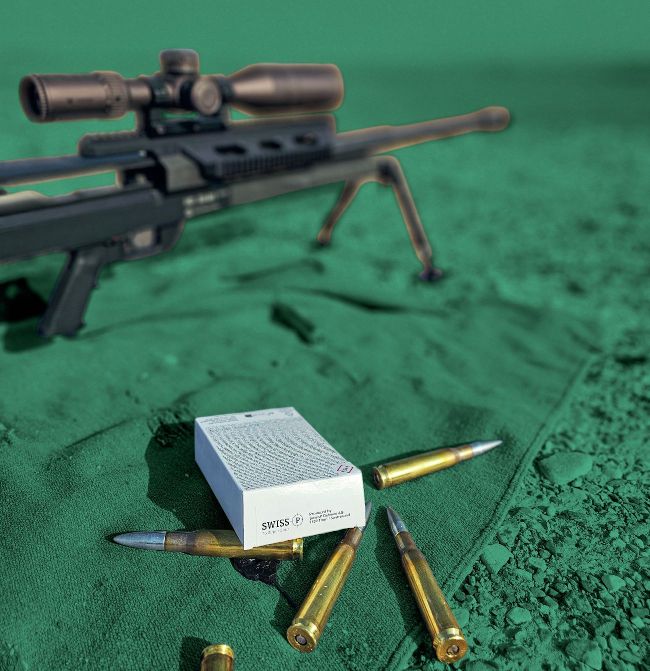
That is the final design that most of us will use today. It may have slight tweaks – a plastic tip to give a very slight increase in ballistic coefficient, or changes to the ogive shape. These will give very small performance gains which may be desirable to those shooting high-level competition. There are also many specialist natures which have their own shape to achieve specific performance criteria. Most of these are at the core level a modified HPBT.

Do I see any trend toward further major development? Currently not, other than lead-free options, but even these mimic the shape of HPBT still. We may have reached a point at which we have harnessed all we can in terms of shape and density and development will be in terms of higher velocity. This will be achieved through propellant and firearm design rather than major changes to projectiles.

This article appears in Mar-26

Go to Page View
This article appears in...
Mar-26
Go to Page View
THE GREAT BRITISH SHOOTING SHOW 2026: A RECORD BREAKING STATEMENT OF INTENT
A record 20% attendance increase, global product launches and landmark brand celebrations confirmed the Great British Shooting Show’s growing influence.
THE RISK THAT BARELY EXISTS
There are occasions when the mood of an
GUN TRADE INSIDER
THE TEAM Group trade editor: Rob Smith •
THE NEWS IN NUMBERS
0.00006 Proportion of all recorded criminal offences involving
SPORTSMAN GUN CENTRE NAMED RETAILER OF THE YEAR AT GREAT BRITISH SHOOTING AWARDS
Sportsman Gun Centre has been named retailer of
BASC AND GTA CHALLENGE HOME OFFICE KNIFE SELLER LICENSING PROPOSALS
The Home Office is considering proposals to introduce licensing requirements for sellers and importers of knives and bladed articles. The following is the joint consultation response submitted by the British Association for Shooting and Conservation (BASC) and the Gun Trade Association (GTA) outlining the trade’s position.
GWCT APPOINTS CHELSEA KING AS AMBASSADOR
The Game & Wildlife Conservation Trust (GWCT) has
BASC COMMUNICATIONS DIRECTOR CHRISTOPHER GRAFFIUS PASSES AWAY
Gun Trade Insider extends its sincere condolences to
SCOTTISH GOVERNMENT MAKES PARTIAL U-TURN ON SPORTING RATES RELIEF
The Scottish Government has partially reversed its decision
SCOTTISH NATURAL ENVIRONMENT BILL RAISES NEW COMPLIANCE QUESTIONS FOR DEER MANAGEMENT AND RURAL TRADE
The Scottish Parliament has passed the Natural Environment
LYALVALE EXPRESS APPOINTS RICHARD FAULDS AS UK GROUP DEVELOPMENT CONSULTANT FOR SHOT SHELLS
Lyalvale Express has appointed Richard Faulds as UK
ISGW AND LEUPOLD ANNOUNCE GLOBAL COLLABORATION WITH UK DISTRIBUTION LINK
The International Sporting Goods Wholesalers (ISGW) alliance and
MOORLAND ASSOCIATION TO APPEAL HIGH COURT DEFRA DECISION ON HEATHER BURNING
The Moorland Association is seeking permission to appeal
SHOT SHOW 2026 REINFORCES INDUSTRY MOMENTUM
SHOT Show 2026 brought together manufacturers, distributors and
GUN TRADE JOBS
MEA OPUS -SECURE YOUR PERFECT FUTURE POSITION -REGISTER AT MEAOPUS.CO.UK
0.00006 PER CENT
Numbers often tell the story more clearly than commentary ever could. When the proportion of gun crime committed by licensed firearms holders amounts to just 0.00006 per cent of all recorded criminal offences, it raises a fundamental question: what problem are policymakers attempting to solve ?
ALIGNMENT ISN’T REFORM — IN REALITY, IT IS AVOIDING THE REAL WORK
With decades of frontline policing experience, Chris Downs, creator and principal advisor at firearmslicensing.net , questions whether proposals to align firearms licensing will deliver meaningful reform, arguing that without addressing long-standing structural weaknesses, the changes risk compounding existing pressures rather than strengthening public safety.
PROJECTILE SHAPE
In this article I thought I would go right back to basics and talk about projectile shape, a subject that most people assume they know about but have rarely actually given much thought to or properly understood. By Paul Bradley.
BE CAREFUL AT THE AIRPORT
Carrying items which are otherwise lawful for you to possess can lead to problems at the airport for dealers and certificate holders, writes barrister Nick Doherty, highlighting key legal risks when travelling internationally.
BERETTA AT 500: FIVE CENTURIES OF INNOVATION, CRAFTSMANSHIP AND VISION
In 2026, Beretta will mark an extraordinary milestone:
WATTS THE STORY?
Mark Watts, co-owner of Just Airguns, shares his business journey, his company’s plans for 2026 and advice for anyone in the trade who is struggling
RICHARD HEFFORD-HOBBS FREng OUTLINES VISION AS PROOF HOUSE COMMITTEE CHAIRMAN GUN TRADE INSIDER
Nearly four centuries after the Worshipful Company of Gunmakers was first tasked with proving firearms for public safety, the organisation continues to evolve in step with a modern shooting industry. Now, with Richard Hefford-Hobbs appointed chairman of the Proof House Committee, the focus is firmly on combining heritage with technical progress and leadership.
BIG LAUNCHES, BOLD DESIGNS: BRITISH SHOOTING SHOW ROUND-UP FROM THE SGC STAND
As the dust settles on the shooting industry’s biggest annual gathering, we take a closer look at some of the most exciting new product launches. At the heart of the show, the SGC Group — home to many of the industry’s favourite brands — unveiled five world-first exclusives alongside a host of new releases set to make a major impact in 2026.
IN THE CROSSHAIRS
The Mamba Lite series of scopes from MTC Optics flies under the radar compared to the company’s other offerings. They’re attractively priced yet lack none of the essential elements that shooters need in a telescopic sight. Nigel Allen put the 4-16x42 model through its paces
A JUNIOR AIRGUN DONE PROPERLY
Mark Camoccio explores why scaled-down, manageable airguns are the perfect way to introduce youngsters to shooting
INTERNATIONAL PERSPECTIVE
ACROSS THE POND BERSA USA APPOINTS TIM DILLON
Looking for back issues?
Browse the Archive >

Previous Article Next Article
Mar-26
CONTENTS
Page 23
PAGE VIEW